Weighted persona panel
Build synthetic users from your real audience mix: acquisition source, device, intent, price sensitivity, lifecycle stage, and category beliefs.
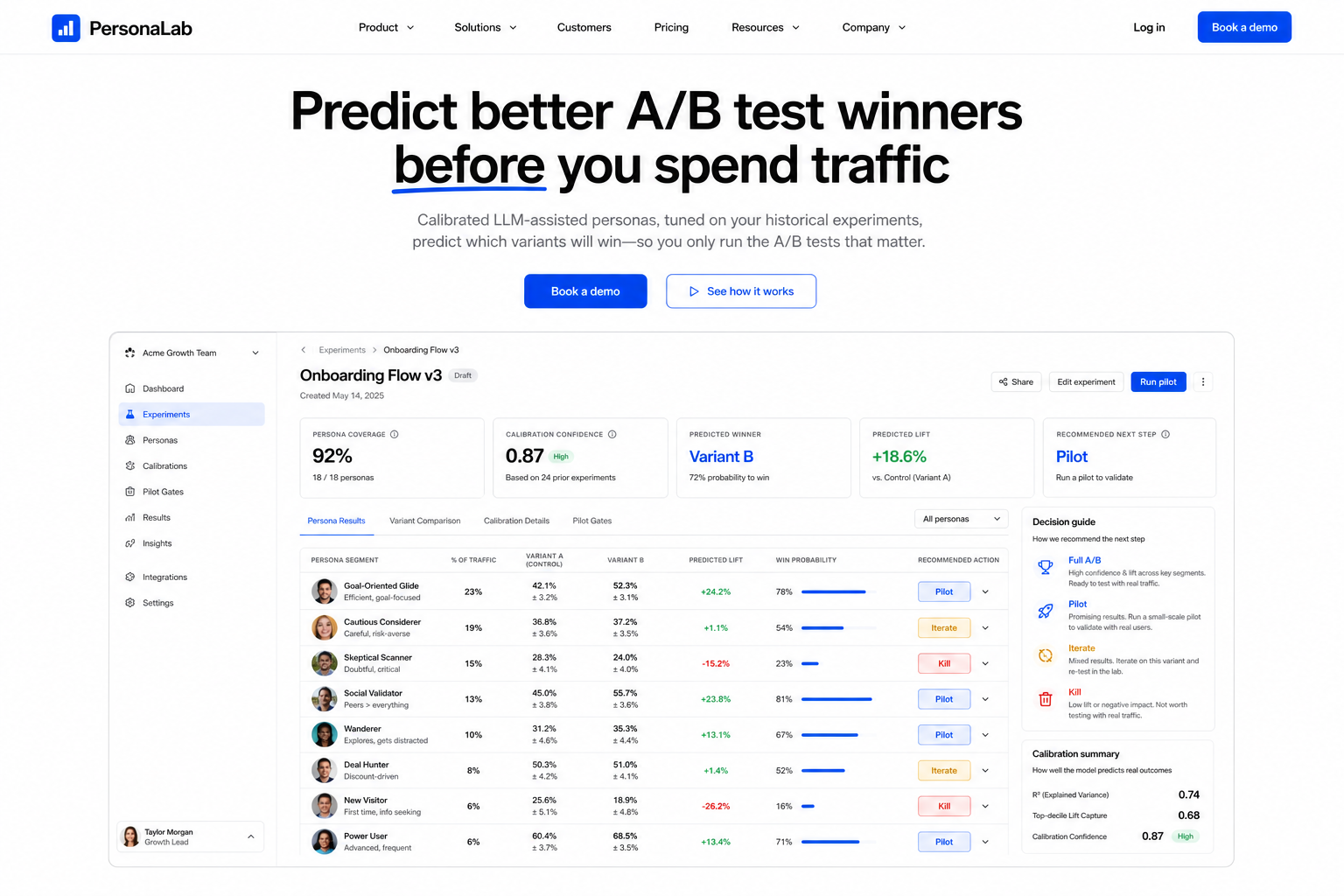
PersonaLab uses weighted AI personas, repeated model draws, historical human experiment calibration, and pilot gates to identify which variants deserve a real A/B test.
Variant ranking
Synthetic panel
Decision gate
Similar to calibrated tests, but outside the strongest overlap region.
Recent research on LLM-based A/B testing shows the trap: if you ask a model which headline wins, you mainly estimate the causal effect on that model. It can be directionally useful, but it is not automatically a human lift.
PersonaLab treats LLMs as surrogate respondents that must be calibrated, stress-tested, and corrected with real experiment data.
Build synthetic users from your real audience mix: acquisition source, device, intent, price sensitivity, lifecycle stage, and category beliefs.
Query each persona many times per variant and aggregate the distribution, reducing single-sample noise and exposing disagreement.
Learn the relationship between synthetic scores and real outcomes from past tests: CTR, signup, trial, purchase, retention, refund, and LTV.
Detect when a new idea is too far from the calibration set and downgrade confidence before the team over-trusts the forecast.
Upload variants, choose the target audience, and connect your experiment history. PersonaLab returns predicted lift, segment-level objections, calibration confidence, and the next best action.
Test trial framing, annual anchors, plan order, cancellation copy, and value proof.
Compare outcomes, objections, category language, social proof, and CTA intent.
Screen hooks before spending on creative production or paid acquisition.
Find where effort creates commitment versus where it creates friction.
The final page keeps the generated concept's restraint, white canvas, product-first hero, and single blue accent while replacing the mockup with production-ready HTML.
PersonaLab is for growth, product, and consumer AI teams that need fewer bad experiments and faster iteration loops.